Loggerhead Shrikes -- Second year effort in fall 2008
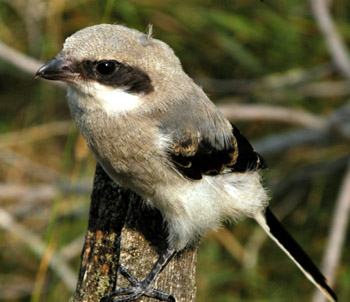 Monitoring help has been requested for a continuing study of Eastern Loggerhead Shrikes. Here is a description of the project by Joe Crowley of the Department of Integrative Biology at University of Guelph, Ontario, Canada:
"The Loggerhead Shrike is a fascinating bird that, despite being a songbird, is also a bird of prey and often impales its prey on hawthorn spines, barbed wire fences, or other sharp objects. This bird, once common throughout Canadian grasslands, is now critically endangered and only a few dozen individuals remain in the wild. In 2001, Wildlife Preservation Canada began a captive breeding and release program in Ontario. Beginning in 2007, we have radio-tracked these shrikes to monitor their survival and dispersal patterns and to identify migration routes and wintering grounds. Although hundreds of birds have been successfully reared and released in Ontario, few have returned in consecutive years. Very little is known about these birds once they leave Ontario, and this research will allow us to better assess the success of the captive-breeding program and help to identify migration routes and wintering grounds."
Here is the request for fall 2008 monitoring, received from Tara Imlay, an intern with the program:
"Once again, Wildlife Preservation Canada, the University of Guelph and York University have teamed up to track Eastern Loggerhead shrikes on their migration from the summer grounds in Ontario to the unknown location of their overwintering grounds. The birds equipped with transmitters are from a captive breeding program currently underway to help bolster the endangered population.
Very little information is known about these endangered birds, in particular, we know very little about their movements and survival after leaving the summer grounds and we are uncertain of where they overwinter. These overwintering sites may have a profound impact on survival. These birds are often found in grasslands, pastures and hayfields and require barbed wire or hawthorn trees on which to impale their prey.
We would great appreciate any help in monitoring the frequencies of these birds as they migrate south. Our transmitter batteries are expected to last until the end of November. Thank-you for your time."
There is no assurance of the migration paths or stopover sites, but these birds are expected to head south from Ontario toward Florida. However, they may overwinter somewhere north of Florida. Therefore, Tennessee, North Carolina and bordering states to the south are particularly important target areas. These radio tag signals are very short "dits" that repeat at approximately one-second intervals. Read this article to get a better understanding of this type of signal and how to identify it.
If you hear a tag signal, make careful note of the date, time, exact frequency, your location (preferably with GPS coordinates), and any unusual signal characteristics. Make tape recordings and/or digital audio files if you can, for analysis and verification. Post your report via e-mail to the biotrackers mail list (see below) or send it to k0ov@homingin.com. If you spot a banded Loggerhead Shrike, please record and report the color and order of the bands on each leg.
The monitoring period for this study concluded at the end of November 2008. No further monitoring is requested at this time.
Read about the Loggerhead Shrike captive breeding program in this article from the Toronto Star.
More information on this and other projects will be posted on this Homing In site page as received. For e-mail notification of these updates, subscribe to the Biotrackers mailing list by sending e-mail to biotrackers-subscribe@yahoogroups.com. The subject line and text are ignored. To prevent spam, only subscribers may post and all new subscriptions must be approved by the List Moderator.
At other pages of this site, you will find ideas for suitable receivers and antennas, a sample tag signal file, plus other tips on hearing and verifying wildlife tags. There are also stories of previous volunteer wildlife monitoring/tracking efforts,
Text copyright © 2008 Joseph D. Moell. All rights reserved.
In the photo: Loggerhead Shrike by Alec Monro
 More pages about wildlife tracking at this Homing In site:
- Frequently Asked Questions About Wildlife Tracking
- Was That Really A Wildlife Tag?
- The Burrowing Owl Project
- The Indiana Bat Project
- The Saw-Whet Owl Project
Back to the Homing In Radio Direction Finding home page
Back to the Hospital Disaster Support Communications System (ARES) home page
 This page updated 7 January 2009