Have You Read These Articles?
 Homing In, CQ Magazine, August 2023 -- "Foxhunters Win Medals in the Lone Star State"
- KC6MEH: "I had no idea what I was getting myself into."
- WB6CMD: "The maps had been used for an orienteering meet three years ago. In that time, vegetation changes and those changes are usually for the worse. It looked on the map like you could run through it, but I tried it and got chewed up by the vines."
- WB6CMD: "I was much slower than usual on 80 meters. My bearings weren't as trustworthy, perhaps because of the rain and wet trees."
- KC9SEM: "Jacob did great. I had him draw bearing lines on the map and then asked where he thought the transmitter would be."
- KC9SEM: "The organizers and other participants were very supportive. It was nice to have people that we didn't know welcome us with open arms, accept us and provide the opportunity to experience the sport."
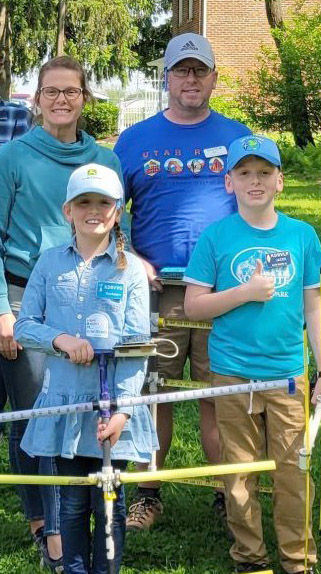
This family hunts transmitters together in Chicago almost every weekend. This year, they all went to the championships in Texas. Patty Sanderson, N9PLS is Mom, Matt Sanderson, KC9SEM is Dad and the junior ops are Mackenzie, KD9VVU and Jacob, KD9VLF. Learn more about these championships in Homing In for August 2023. (Photo by Bob Frey WA6EZV)
 CQ Magazine, May 2023 -- "Close Encounters of the Law-Enforcement Kind"
46
- "Two cruisers pulled up behind as I rolled into the closest parking lot. The officers seemed to be in awe of the four-element quad on top of the van, with the mast going through the roof."
- "Veteran officers are used to our strange antenna arrays and slightly erratic driving. Normally, it takes something blatant to get them to pull you over---such as the hunter who backed his car down a freeway on-ramp some years ago."
- "Don Lewis KF6GQ put on a hunt with the low power transmitter in a box under the reception desk at the Monrovia police station. It took a lot of courage to walk through the door to probe the lobby of a precinct house."
- "If your local hunt participation is falling because the hunts are too hard for some, why not have a well-publicized mobile hunt that's designed just for beginners once in a while?"
- "For a successful mobile foxhunt that encourages first-timers, the teams should all start from the same location. There should be a huntmaster at the start to help new teams to get their initial bearings, if necessary."
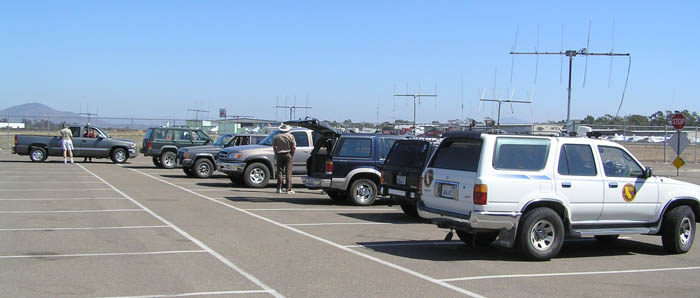
The big parking lot at Montgomery-Gibbs Executive Airport serves as starting point for many mobile transmitter hunts in the San Diego area. Most of the teams on this hunt are using rotatable two-meter quad or yagi antennas for RDF. Read more about T-hunts for beginners in Homing In for May 2023.
 Homing In, CQ Magazine, February 2023 -- "Results of the 25th CQ Worldwide Foxhunting Weekend"
- "W7BDB: 'Robin and I got a good heading from the start and then it all went sideways. We probably put on twenty miles driving around a transmitter that was only a shade over a mile away.'"
- "N6SZO: 'We had 22 total participants out on the course. Some did not yet have their ham licenses and were trying it for the first time.'"
- "K9PW: 'Once several hunters are in the area, I often walk around with one or more of them and transmit through the fox with my UHF portable. It can be very entertaining to watch the hunters!'"
- "N9SCD: 'Back when I started T-hunting, I heard about some unique hides. One of them had a balloon floating out of sight, in the dark. I couldn't resist.'"
- "AJ6WB: 'The goal of this event is to equip, train and practice the fundamentals of direction finding for all ages. There will be gear available for those who need it so that all can enjoy the event.'"
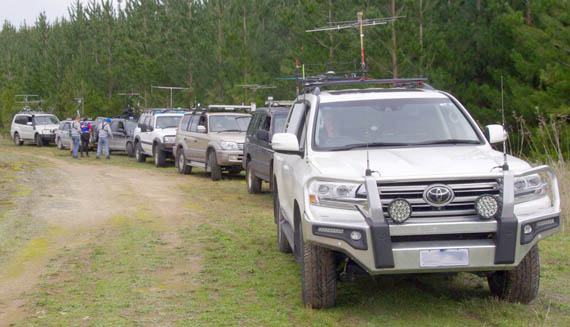
Mobile T-hunters are lined up for Event 2 at the Australian Foxhunting Championships at Mt. Gambier in June. The events take place on several bands, so each vehicle has multiple RDF antennas. Read more about 2022 transmitter hunting around the world in Homing In for February 2023. (Photo courtesy SERG)
 Homing In appeared monthly in 73 Magazine from November 1988 until the magazine ceased publication with the September 2003 issue. My column then appeared in CQ VHF magazine, a quarterly publication, from 2004 through Fall 2013 and CQ-Plus Digital Magazine during 2014. Now it appears four times per year in CQ Magazine. I welcome your input for future articles, so please continue to send me your news of mobile and on-foot transmitter hunt activities.
The Fine Print: This is the official Web site for Homing In and other KØOV articles about RDF, but not for any magazine. Homing In articles are produced independently in southern California. Text and artwork of all articles Copyright © Joseph D. Moell. All rights reserved.
 Surfing suggestion: Wondering what you've been missing by not reading Homing In since 1988? Check the complete index of topics at this site.
 Back to the Homing In home page
This page updated 25 November 2023