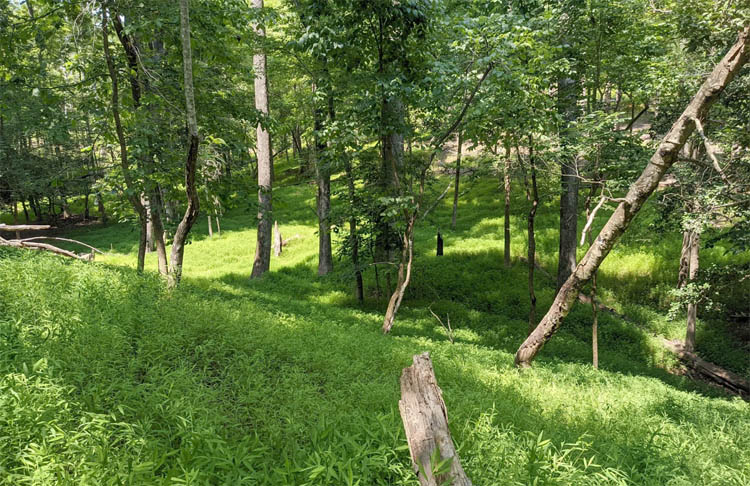
Morrow Mountain in North Carolina was the site of the 2025 USA ARDF Championships.
 When first formed, the Uwharrie Mountains of central North Carolina rose to nearly 20,000 feet above sea level. Erosion has gradually worn them down to the high hills that they are today. The top of Morrow Mountain is only 936 feet, but it's beautiful and the area is perfect for ARDF.
Morrow Mountain State Park was developed through the 1930s and named after James McKnight Morrow, a major land donor. It is 40 miles northeast of Charlotte and 90 miles southwest of Raleigh. Today the park has 5,881 acres and 32 miles of well-maintained trails. With excellent maps by Carolina Orienteering Klubb, it was an ideal location for the 2025 USA Radio-Orienteering Championships.
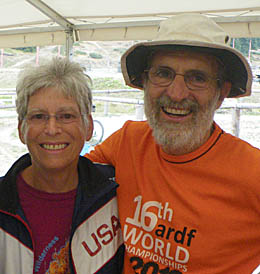
Organizing these championships were members of Backwoods Orienteering Klub. Joseph Huberman K5JGH was the Event Director and Ruth Bromer WB4QZG was the Registrar (both pictured at right above). Designing the courses was Charles Scharlau NZØI. All three have been consistent medal winners at previous USA Championships and have competed in the ARDF World Championships.
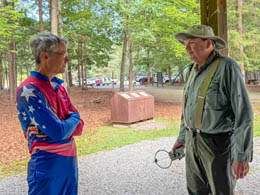 Attending were about thirty fans of on-foot hidden transmitter hunting from USA and Canada. Some took advantage of the campgrounds and cabins at the park, while others spent nights in nearby Albemarle. Traveling from southern California were long-time radio-orienteers Bill Wright WB6CMD and Scott Moore KF6IKO (pictured at left). "We got really lucky with the weather," Bill reported. "We finished before the big heat wave came in. I think on the worst day it was up in the nineties, which was miserable enough but not as bad as we feared. We were usually on course by 9:30 and people were pretty much done by noon. But you can't get around the fact that when it's 90 degrees with eighty to ninety percent humidity, it's going to be miserable sometimes. They had controlled burns on part of the map we were using, which really cleared out a lot of the low-lying vegetation. That was good for orienteering. I didn't encounter a single tick and the bugs were pretty minimal."
Starting on Saturday, June 14, four days of training and practice were hosted by K5JGH and WB4QZG near their home in Asheboro. The action moved to Morrow Mountain State Park on Wednesday for equipment checks, an information meeting and pizza.
Thursday was the first day of formal competition, foxoring. It closely resembles classic orienteering because there are circles on the provided map near the continuously-transmitting low-power 80-meter transmitters. Competitors use their orienteering skills to get to the circle locations, then perform direction-finding to home in on the foxes that can only be heard there.
The foxoring course was in the northern part of COK's mapped area, between a campground and the Pee Dee River. There were ten transmitters on three frequencies, separated by about 500 meters. Only competitors in the M21 category were required to find them all. Winning gold and having his best day of competition was Gheorghe Fala, who found them all in 59:23. W35 and M50 categories had eight required foxes. Lori Huberman was best for eight at 51:06.
Friday's event was the sprint, in which the transmitters are on for 12 seconds in sequence. The course has two loops. The first has five slow-keyed 80-meter transmitters on one frequency. The second has five fast-keyed 80-meter transmitters on another frequency. Competitors run through the start corridor leading to the area with slow-keyed transmitters. After finding all of the required transmitters from the first loop in any order, they run through a spectator corridor to the area with fast keyed foxes. After finding all required transmitters from this loop in any order, they run to the finish line.
To make the foxes easier to distinguish from one another during their short transmissions, the slow-keyed ones sent ME, MI, MS, MH and M5. The fast-keyed ones sent OE, OI, OS, OH and O5. The compact course was next to the parking area and a shelter to encourage spectators.
Eduard Nasybulin was fastest in M21, the only category required to find all ten sprint foxes. He did the course in 30:58, which was more than twelve minutes faster than second-place finisher William Allen. For the categories with eight required foxes (W35 and M50), Matthew Craig was fastest at 24:41.
The hardest event of a radio-orienteering championships is usually the two-meter classic, which took place on Saturday. Classics got their name because they were the first form of radio-orienteering. Five transmitters are placed at least 400 meters apart. They transmit for 60 seconds each in rotating order on the same frequency. Competitors are individually timed as they travel from the starting point to the finish, finding the transmitters required for their category along the way in any order. There are no transmitters within 700 meters of the start and 400 meters of the finish, except for a continuous beacon on another frequency near the finish line to help those who get lost, lose their map or break their glasses. To insure fairness, there are many additional rules for classic events, covering impounds, start procedures, course monitoring, protests and so forth.
The classics map encompassed 1850 acres. According to WB6CMD, "It was a compact area, which made it a challenge for the course designer. Charles did a pretty good job of finding good fox locations. Everyone was predicting beforehand that it would be really difficult on two meters due to the terrain and moisture. There was a lot of apprehension going into it, but I got pretty good bearings leaving the exclusion zone and they held up approaching the transmitters. There was one on which I didn't get good bearings early on. Fortunately it was far enough away and I knew the order I wanted to take. As I got close, the bearings cleared up and I found it on a little knoll next to the river."
Bill Wright's time for his three required foxes was 1:28:06, which earned him a silver medal in M60 category. The M60 winner was Evgeny Danilov in 1:13:24. In the other three-fox adult categories (W55, W75 and M70), the best time was turned in by Nadia Scharlau KO4ADV at 1:08:18. In the five-fox M21 category, the gold medalist was Eduard Nasybulin in 1:57:20.
In 2024, WB6CMD won M60 gold in all four events, but he was not disappointed with his two medals in 2025. "Nicolai Mejevoi and Iurii Kolesnykov weren't at the USA championships in 2024. Evgeny Danilov KQ4QYZ has really improved. I was very impressed with his skills and his performance. So the competition was much more intense. I think I did better than some years before. I seemed to have my act together and didn't make as many blunders."
Sunday was the final competition day with the 80-meter classic event. The map area was the same, but the start and finish points were reversed, so competitors had to walk in to a high point to get to the starting line. Bill Wright reported that the entire area was very good for orienteering. "The trails didn't help all that much, and the terrain was open enough that on 80 it was best to just go directly toward the signal. The small amount of green on the map overemphasized the vegetation."
It is typical for 80-meter course times to be faster on average than for two-meter equivalent courses. Eighty-meter signals do not reflect from terrain features to cause incorrect and confusing bearings like two-meter signals often do. The nulls on 80-meter ARDF sets provide sharper bearings than the pattern peaks of two-meter yagis. In addition, 80-meter receiver-antenna sets are smaller, lighter and less awkward to carry than two-meter sets.
In this 80-meter classic, Eduard Nasybulin was winner in the five-fox M21 category, finding them all in 1:00:39. He was just seven seconds faster than second place Gheorghe Fala. Nadia Scharlau KO4ADV had the best pace of the day, finding her three W55 required foxes in 41:22.
The championships went very smoothly, to the delight of Course Designer NZØI. He wrote, "All of the competition's radio equipment worked flawlessly. Some of the transmitters were placed in the woods as much as eight days before they were scheduled to operate. They all came on at their prescribed times and timing of transmissions was well within the maximum overlap rules. Spreading the deployments out over a four-day period made it very manageable for a single course setter to handle the task. I even had time to attend meetings and the banquet!"
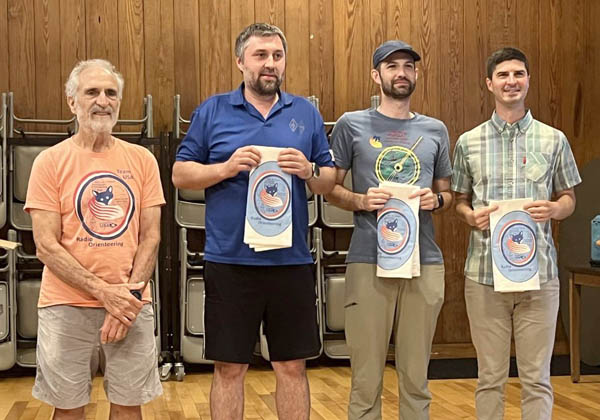
Congratulations to all of the gold medal winners. They are, in alphabetical order:
      Anastasia Afonkin        W16   foxor sprint 80m
      Ruth Bromer WB4QZG       W75   foxor sprint 2m 80m
      Maria Burrus             W55   foxor
      Matthew Craig            M50   sprint
      Evgeny Danilov KQ4QYZ    M60   foxor 2m
      Gheorghe Fala            M21   foxor
      Robert John Haddow       M50   foxor
      Erin Hammer              W35   2m 80m
      Joseph Huberman K5JGH    M70   foxor sprint 2m 80m
      Lori Huberman            W35   foxor sprint
      Jonathan Kross           M40   80m
      Natalia Leoni            W55   sprint
      Nicolai Mejevoi          M60   sprint 80m
      Alexander Myachin        M50   2m 80m
      Eduard Nasybulin         M21   sprint 2m 80m
      Adalia Schafrath-Craig   W19   foxor sprint 2m 80m
      Nadia Scharlau KO4ADV    W55   2m 80m
      Tiger Zhao               M16   foxor sprint 2m 80m
Here are links to the official results:
FoxOring competition, Thursday, June 19
Sprint competition, Friday, June 20
2-meter Classic competitionay, Saturday, June 21
80-meter Classic competition , Sunday, June 22
Over 140 photos have been posted by the participants.
Joe Moell KØOV

 Go to Championships Foxhunting News -- Recent and upcoming ARDF championships events
Go to International-Style Foxhunting Comes To The Americas -- How we're getting the ball rolling
Go to Equipment Ideas for Radio-Orienteering -- Simple and inexpensive receiving and transmitting solutions
Go to Radio-Orienteering News for Southern California -- Results and stories of recent radio-orienteering events in southern California, plus announcements of upcoming ones.
Go to Foxhunting for Scouts -- Let's get the kids involved
 Back to the Homing In home page
This page updated 8 October 2026