Championship ARDF News
From USA and Around the World

From that successful beginning, ARDF interest and activity grew. In 1999 the first IARU Region 2 ARDF Championships took place in forested areas near Portland, again under the leadership of WB6BYU. Those foxhunts on two meters and 80 meters drew competitors from all over the USA and six foreign countries.
USA's national ARDF championships have taken place annually (except during COVID) since 2001. For 2026, it was a long-awaited return to the Pacific Northwest. Dale Hunt came out of retirement to be Event Director, sharing organization and course design duties with ARRL ARDF Co-Chair Charles Scharlau NZØI. They partnered with Mt. Hood Orienteering, which sponsors numerous classic orienteering meets annually and has mapped many challenging forested areas around that 11,240-foot mountain. Mapper for these championships was Tony Pinkham KA7AHP. Registrar was Kathleen Kerns K7KER. Also assisting were long-time ARDF enthusiasts Jay Hennigan WB6RDV and Woody Jackson.
Original plans were to hold the four competitions at four venues: White River Sno-Park East and West, Skyline Sno-Park and Billy Bob Sno-Park. But in early August, a multitude of forest fires broke out. The "Grasshopper Fire" northeast of Mt. Hood ignited almost 100,000 acres. The resulting smoke and congestion made all of the planned sites except Skyline Sno-Park unusable. The Forest Service gave permission to move all of the ARDF events to Skyline, forcing redesign of the sprint and classic courses.
"The Grasshopper Fire started about 15 miles NE of the Skyline venue," Dale reported. "The fire was burning in difficult terrain. It eventually burned most of the Badger Creek Wilderness, as well as threatening small communities to the East. A couple of weeks before the event, the Forest Service put out a closure notice for a large area enclosed by two major Forest Service roads. The Billy Bob venue was just inside the north edge of this. Charles and I had worked on laying out both classic courses on this map, and we had to switch it to Skyline, which was somewhat smaller than optimum. By the time of the event, the roads along the West and South edges of the Billy Bob map ended up being the active fire lines where the fire was stopped, with only a little slopover onto the rest of the map. Then the wind shifted from the East and blew the fires toward Highway 35, which connects the town of Government Camp to Hood River in the Columbia River Gorge on Interstate 84. That put our White River venues in a Level 2 evacuation zone, so the company in Hood River wouldn’t deliver the portable toilets that were required under our Forest Service permits. That’s when we had to move the Sprint competition to Skyline as well. Government Camp, where many competitors stayed, was under a Level 1 'Be Ready' evacuation order the whole time, as was the area across the highway to the east of the Skyline map."
According to Charles, "Weather was great, with high temperatures probably in the upper 70s and mostly sunny with light to moderate westerly winds developing by late morning or early afternoon that kept the smoke at bay. One morning was cloudy, with rain on the pavement while driving up through ZigZag and Government Camp, but Skyline is just over the crest of the Cascades and didn’t get any rain."
The biggest problem for competitors was the myriad of downed trees on the courses, the result of wind and snow loading through the years. According to competitor Bill Wright WB6CMD, "For the most part, there was no way to avoid it and the map was not particularly helpful in that regard. The downed trees affected my speed traveling through the forest. My legs received a few scrapes from the deadfall, but nothing serious. I was sore afterwards from climbing over the tree trunks." Others were not so fortunate. There were two bad falls on the last day, one resulting in a broken wrist and another causing a deep arm laceration.
The first competition was the Sprint on Thursday, August 13. The 1.61 kilometer course was within the exclusion (no-fox) zone that would later be on the map for the classic courses. "The sprint course was straightforward," Bill reported. "There was only one fast transmitter that I lost some time finding. Otherwise, the controls were visible on the poles as you approached them on the correct bearing." Nadia Scharlau in W65 category had the best overall time of the day, finding her six required transmitters in just 18:33. Second overall for the day was Vadim Afonkin KB1RLI in M50, finding his required eight foxes in 19:59.
Next day was foxoring on the longest course of the championships (5.48 km). "The foxoring course presented some navigational challenges to features that were somewhat indistinct on the map," Bill wrote. "This was compounded by what I thought were weak signals from many of the controls. I often struggled to hear controls from 100 meters away. However, once I got a strong signal, it was easy to locate the controls." Gheorghe Fala in M21 had an amazing race that day, finding all eleven controls in 1:11:41.
Everyone had difficulty in the two-meter classic event on Saturday due to VHF signal bounces on the 3.9 km course. According to Charles, "One of the transmitters was particularly difficult to find due to reflections, even though it was on a hill close to the road." Bill wrote, "It was my worst event, and I suspect for most of the other competitors as well." The best time to find all transmitters was turned in by Andres Viira (a visitor from Estonia) in M50 at 1:35:58. Nicolai Mejevoi in M60 was required to find four foxes and did it in 1:33:48.
The final event was the 80-meter classic, a 3.75 km course on Sunday morning. "As expected, 80m was a pleasant change from two meters," Bill reported. "At least I could trust the bearings. However, judging distance to the controls using signal strength was a bit of a challenge. Additionally, Charles placed the transmitters such that one or two trips through the forest was required, as there were only two trails/roads on the map to use. As a result, my route choice was suboptimal." Gheorghe Fala in M21 found all foxes in 55:05, followed closely at 57:21 by Vadim Afonkin in M50.
Dale reported on the newcomers: "Mike Poulsen KK7RQD and Mitch Collinsworth K2VD are orienteers who were trying Radio-O for the first time. In the youth category (M19), Anthony 'Toto' Papathanasopoulos K7ASP had his mother drive him two hours to one of my practice sessions beforehand and he did well with just that experience. At the practice, his mother, Lucie Gouin KK7URH, asked if she could try it. She had so much fun that she signed up and took home some medals in W45."
Congratulations to all who took first place in their categories. They are, in alphabetical order:
Photos and complete results are in the Mt. Hood Orienteering Web site.
Joe Moell KØOV
USA's national society (ARRL) is a member of IARU Region 3 by virtue of its territories in the western Pacific ocean. Therefore USA is invited to send a team to the championships. Full membership in Team USA is open to US citizens, green card holders, and/or anyone who has lived in the United States for the past year. Non-qualifying radio-orienteers may also compete as independent visitors.
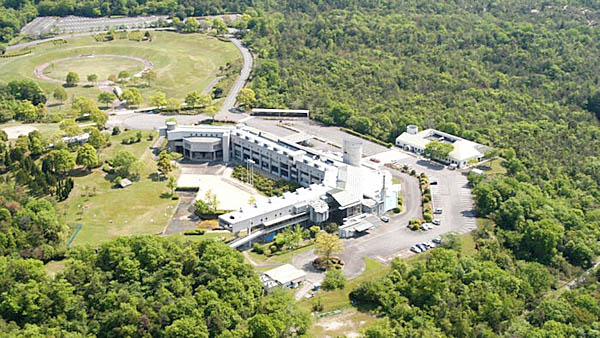
Ryuo Town is in the Shiga Prefecture of the Kansai Region of Japan. Kansai is in the south-central part of Honshu, the main island. The town is about 30km east of the Kyoto railway station. Team members must fund their own transportation expenses to and from the competition.
USA's team selection is now complete. More information is in the event Web site: https://www.jarl.com/2026reg3ardf/
Robert became an eager participant when ARDF first came to Ottawa, Ontario. In his QRZ page, he writes, "In fall 2019, an ARDF group was formed by Roger Egan VA3EGY with members from a number of the local ham radio clubs. ARDF has been an interest of mine since taking part in a couple of transmitter hunts and it allows me to combine two of my favorite hobbies, orienteering and Amateur Radio. There's been a lot of interest from local hams and we have put together some equipment kits including an offset attenuator and three-element Yagi. We have been organizing some local events and found a great way to engage youth groups with STEM activities."
The ARDF Ottawa Web site has more information about transmitter hunting in eastern Ontario.
ARDF in Canada got its start in British Columbia when the Third Friendship Radiosports Games took place in Victoria in 1993. Its organizers formed the nucleus of a group that continued to grow and promote ARDF throughout the country. In 1997, Perry Creighton VA7PC (SK) of Victoria, one of the Friendship Games organizers, was selected by RAC to became the first national ARDF Coordinator in North America. Joe Young VE7BFK, a participant in the 1993 Friendship Games, succeeded him as RAC's ARDF Coordinator in 2002 and continued until his retirement in 2025. Radio-orienteers from British Columbia have competed in several USA ARDF Championships. In 2010, RAC sent a team to the ARDF World Championships for the first time, with VE7BFK as one of its members.
Organized by the Lithuanian Amateur Radio Society, the 22nd IARU World Championships took place in Birstonas from August 16 through 22, 2025. This city of 3,000 residents is 50 miles west of Vilnius, the capital and largest city in Lithuania. There were separate classic ARDF events on separate days for national teams on eighty meters and two meters, each with up to five transmitters scattered in a forest that might encompass 1000 acres or more. There were also competitions in sprints and foxoring.
For the World Championships, each country may send up to three competitors for each event in each of twelve age categories, six for males and six for females, in accordance with rules of the International Amateur Radio Union. Team members are responsible for their own registration/room/board fees and for transportation expenses to and from Lithuania.
USA has been represented at every one of these ARDF World Championships since 1998, and 2025 was no exception. Team USA selection in competed categories (where more than three wish to attend) was based on performances and standings in qualifying events including the 23rd USA ARDF Championships (Michigan, October 2024) and the 24th USA ARDF Championships (North Carolina, June 2025). Co-chairs of the ARRL Team Selection Committee were Ruth Bromer WB4QZG and Nadia Scharlau KO4ADV.
Once again, Team USA was on the medal podium. Nadia Scharlau KO4ADV won an individual silver medal on 80 meters in the second classic event on August 21. In W55 category on that date, the combined scores of Nadia Scharlau, Alla Mezhevaya and Maria Burrus captured bronze for USA in the team competition.
In addition, the following team members had top-ten finishes:
Congratulations to all!
Complete results are in the ARDF Web site of Germany. Ken Harker WM5R, who is ARDF Coordinator for IARU Region 2, served as a juror at these championships. He has posted his photos here.
For more about the 2025 ARDF World Championships, visit the World Championships Web site of the Lithuanian Amateur Radio Society.
Joe Moell KØOV
This article has been updated and moved here.
This fund was first established in year 2000 with "seed money" from the Colvin Award, the ARRL Foundation and the ARRL General Fund. In its first five years, payments from the fund were made on behalf of 18 individuals to help defray the cost of their participation in three ARDF World Championships. Grants from the fund have also been made to the organizers of two USA ARDF Championships.
No further contributions are anticipated from the original sources, so the fund has been opened to contributions from individuals and clubs. All contributions are tax deductible to the extent allowed by law and will be acknowledged by ARRL, a registered 501(c)(3) organization. Contributions may not be designated by donors to be granted to any specific recipient, individual or group.
Grants from the fund may be requested by groups sponsoring ARDF events in the USA and by individuals who have qualified to represent the USA in ARDF competitions sanctioned by the ARRL or the International Amateur Radio Union (IARU). Requests for grants should be submitted electronically at least 60 days in advance of need to the Development Office at ARRL Headquarters. They will be reviewed by a committee that includes ARRL's Chief Executive Officer, Chief Development Officer and ARDF Committee.
You can help support ARDF in the USA by sending a donation to ARDF Development Fund, c/o ARRL, 225 East Main Street, Newington, CT 06111. Checks should be made out to ARRL with "ARDF Development Fund" on the memo line.
The not-for-profit American Radio Relay League (ARRL) is the national association of Amateur Radio operators, founded in 1914. ARRL is a member society of the IARU.
Go to Equipment Ideas for Radio-Orienteering -- Simple and inexpensive receiving and transmitting solutions
Go to Radio-Orienteering News for Southern California -- Results and stories of recent radio-orienteering events in southern California, plus announcements of upcoming ones.
Go to Foxhunting for Scouts -- Let's get the kids involved
Go to Extenders Aid Handicapped Foxhunters -- A novel way to include persons with disabilities
This page updated 8 October 2026

Some of the competitors and organizers in the 2026 USA/R2 championships near Mt. Hood. (Courtesy Mt. Hood Orienteering)
The 25th USA Radio-Orienteering Championships
And 13th IARU Region 2 Championships
Mt. Hood, Oregon, August 12 - 16, 2026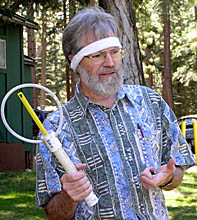
 Back in 1991, USA's first international on-foot transmitter hunt using IARU rules took place in Portland, Oregon. Visiting radio-orienteers from USSR and Japan came to the City of Roses to compete against the Northwest ELT Team and some southern California transmitter hunters as part of the Friendship Radiosport Games. Organizing this two-meter event in Portland's Forest Park was Dale Hunt WB6BYU (at left).
 Dale continued, "Just before Charles arrived to start setting the course, the wind changed and the smoke was tolerable. For the first couple days of the championships, you could smell it in the air at times, especially in the mornings before the wind came up. But after that it cleared up and we had nice weather. We had a supply of KN95 masks on hand in case the wind shifted."
      Vadim Afonkin KB1RLI             M50  Sprint Foxor 80m
      William Allen KG4OQO             M21  2m
      Adalia Schafrath-Craig KA4CSC    W19  Sprint Foxor 2m 80m
      Gheorghe Fala                    M21  Foxor 80m
      Lucie Gouin KK7URH               W45  Sprint Foxor 2m 80m
      Erin Hammer                      W35  Sprint Foxor 2m 80m
      Nicolai Mejevoi                  M60  Sprint Foxor 2m 80m
      Alla Mezhevaya                   W55  Sprint Foxor 2m 80m
      Eduard Nasybulin                 M21  Sprint
      Anthony Papathanasopoulos K7ASP  M19  Sprint Foxor 2m 80,
      Nicholas Roethe DF1FO            M70  Sprint Foxor 2m 80m
      Nadia Scharlau KO4ADV            W65  Sprint Foxor 2m 80m
      Andres Viira                     M50  2m

All events took place in Skyline Sno-Park, near the Grasshopper Fire. (From Watch Duty)
Announcing the 15th IARU Region 3 ARDF Championships
Ryuo Town, Japan, November 9 - 14, 2026 Japan Amateur Radio League (JARL) announces the 2026 IARU Region 3 ARDF Championships, which will take place in Ryuo Town, Japan from November 9 - 14, 2026. There will be competitions in sprint, foxoring and classics on 80 meters and 2 meters.
New ARDF Coordinator for Canada is Appointed
 Robert Haddow VE3JT/VE3RXH of Kemptville, Ontario (at right) is the new ARDF Coordinator for Radio Amateurs of Canada (RAC). He succeeds Joe Young VE7BFK, who has served in that position since 2002. Robert is a skilled radio-orienteering competitor who has been a frequent participant in the ARDF championships of USA and IARU Region 2 (North and South America). In the 2025 USA ARDF Championships in North Carolina, he took gold in M50 category in the foxoring competition.
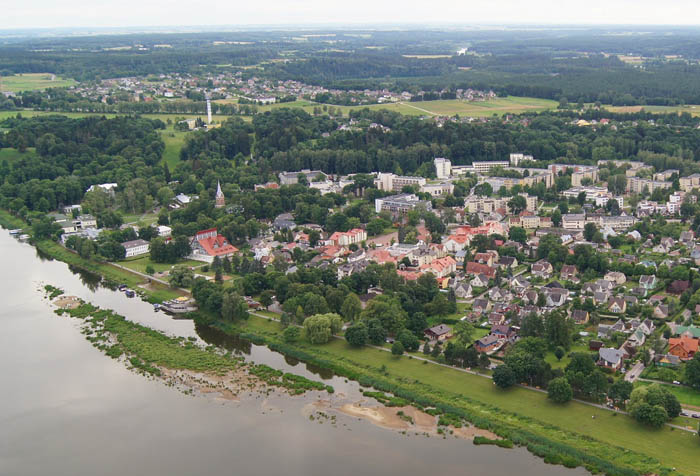
Along the Nemunas River, the beautiful resort village of Birstonas, Lithuania hosted the 2025 ARDF World Championships
The 22nd ARDF World Championships
Birstonas, Lithuania, August 16 - 22, 2025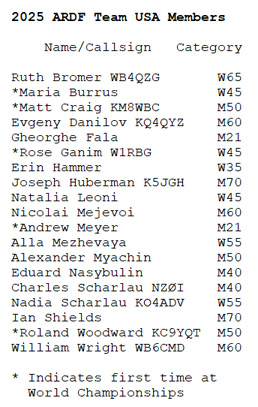
 Nestled on the banks of the Nemunas River and surrounded by beautiful pine forests, Birstonas, Lithuania is known for its therapeutic mineral springs and natural landscapes. Visitors flock to this spa town to indulge in various wellness treatments, soak in healing mineral baths, and immerse themselves in nature. But for more than 300 radio-athletes from 25 nations, their trip to Birstonas was an opportunity to find out who is best at the world at finding radio transmitters in the woods.
     Nadia Scharlau     W55  5th in Sprint, 7th in 2m Classic
     Erin Hammer        W35  6th in Foxor,  8th in 80m Classic
     Ruth Bromer        w65  6th in Foxor,  10th in 80m Classic, 10th in Sprint
     Alexander Myachin  M50  5th in Foxor,  7th in Sprint
     Natalia Leoni      W45  8th in Foxor,  8th in 80m Classic
     Alla Mezhevaya     W55  10th in Foxor
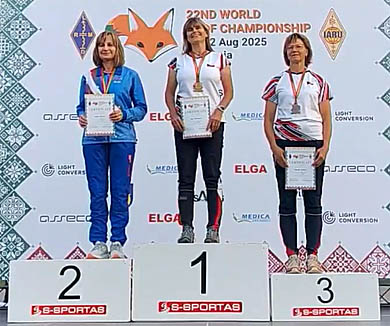
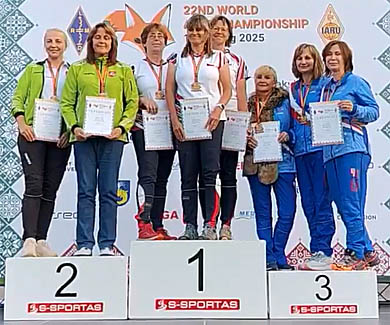
At left, Nadia Scharlau KO4ADV won silver in the second Classic event on 80 meters. Here she is on the medal stand with the first and third place winners, both of whom are from the Czech Republic. At right, Team USA won bronze in the W55 category on 80 meters. On the medal stand in their blue uniforms are Maria Burrus, Nadia Scharlau and Alla Mezhevaya.
The 24th USA National Radio-Orienteering Championships
Albemarle, North Carolina, June 19 - 22, 2025Same Sport, New-ish Name
 This Homing In site has used the terms "ARDF" and "Radio-Orienteering" interchangeably with respect to on-foot transmitter hunting under international rules. Both terms are recognized in most countries where the sport is performed (see example at right from Czech Republic). However, ARDF is often confused with in-vehicle transmitter hunting (which I prefer to call "T-hunting"). Now the ARRL ARDF Committee has decided to emphasize the term "Radio-Orienteering" to help minimize confusion. The Committee sent this message on June 20, 2022:
ARRL ARDF Development Fund Seeks Donations
 The ARRL Fund for the Development of Amateur Radio Direction Finding is now accepting monetary donations to support deserving groups and individuals as they expand international-rules ARDF activities in the USA.
Results and Photos of Other Stateside ARDF Events in Recent Years
 Current SoCal sessions -- Southern California practice/demonstration events of 2026. SoCal 2025 -- Southern California practice/demonstration events of 2025, including Yuma Hamfest, Hillcrest Park, Ocean Beach and Veteran's Memorial Park. SoCal 2024 -- Southern California practice/demonstration events of 2024, including Hillcrest Park and Mission Bay Park. SoCal 2023 -- Southern California (and Arizona) practice/demonstration events of 2023, including Hillcrest Park and Balboa Park. SoCal 2022 -- Southern California (and Arizona) practice/demonstration events of 2022, including Yuma Hamfest, Hillcrest Park and Felicita Park. SoCal 2021 -- Southern California practice/demonstration events of 2021, including Lake Los Carneros, Hillcrest Park and Bonelli Regional Park. (There were no events in 2020 due to COVID.)
June 19 - 22, 2025 -- 24th USA ARDF Championships near Albemarle, NC. October 9 - 13, 2024 -- 23rd USA ARDF Championships near Chelsea, MI. April 19 - 23, 2023 -- 22nd USA ARDF Championships near Sulphur Springs, TX. April 7 - 10, 2022 -- 21st USA ARDF Championships in Triangle, VA. October 14 - 17, 2021 -- Twentieth USA ARDF Championships in North Carolina.
Current SoCal sessions -- Southern California practice/demonstration events of 2026. SoCal 2025 -- Southern California practice/demonstration events of 2025, including Yuma Hamfest, Hillcrest Park, Ocean Beach and Veteran's Memorial Park. SoCal 2024 -- Southern California practice/demonstration events of 2024, including Hillcrest Park and Mission Bay Park. SoCal 2023 -- Southern California (and Arizona) practice/demonstration events of 2023, including Hillcrest Park and Balboa Park. SoCal 2022 -- Southern California (and Arizona) practice/demonstration events of 2022, including Yuma Hamfest, Hillcrest Park and Felicita Park. SoCal 2021 -- Southern California practice/demonstration events of 2021, including Lake Los Carneros, Hillcrest Park and Bonelli Regional Park. (There were no events in 2020 due to COVID.)
June 19 - 22, 2025 -- 24th USA ARDF Championships near Albemarle, NC. October 9 - 13, 2024 -- 23rd USA ARDF Championships near Chelsea, MI. April 19 - 23, 2023 -- 22nd USA ARDF Championships near Sulphur Springs, TX. April 7 - 10, 2022 -- 21st USA ARDF Championships in Triangle, VA. October 14 - 17, 2021 -- Twentieth USA ARDF Championships in North Carolina.
Additional ARDF Resources In This Site
 Go to International-Style Foxhunting Comes To The Americas -- An introduction to the sport with the history of its development in the Western Hemisphere
 Back to the Homing In home page